The Seven Hunters
The Flannan Isles lie twenty miles west of the Isle of Lewis in the Outer Hebrides — seven small islands of dark gabbro and ancient gneiss that rise from the Atlantic without warning. The largest, Eilean Mòr, is 43 acres of cliff and grassland. There is no harbour, no beach, no shelter. On all sides the rock drops straight into deep water. The islands sit directly across the shipping lanes running between North America and the Clyde ports. Before the lighthouse, they were a hazard in the dark.
The Northern Lighthouse Board broke ground in 1895. Everything had to be lifted vertically from supply vessels — every stone, every lens component, every barrel of paraffin — up cliff faces to the building site. The engineers installed a cable-hauled railway on a forked track to carry materials between two separate landing stages and the lighthouse above. The west landing faced the open Atlantic. The east landing offered slightly more shelter. Neither was safe in any real sense. The light was first lit on 7 December 1899.
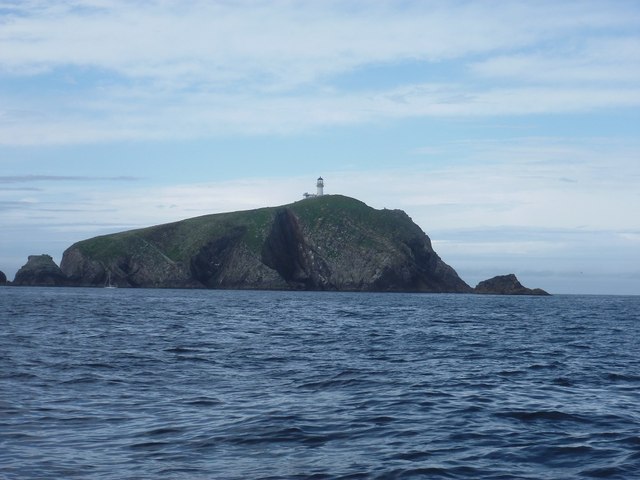
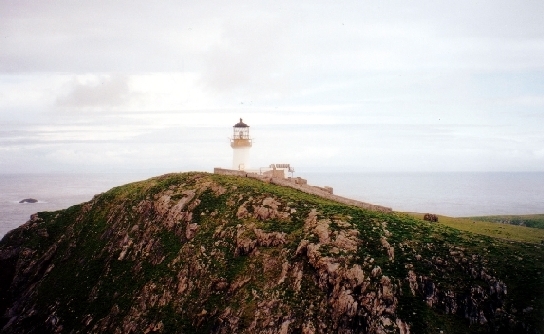
The tower stands 75 feet tall in white masonry, sitting near the island's highest point at a focal height of 331 feet above sea level. Attached to it: a one-storey keepers' dwelling with separate bedrooms, a common kitchen, enough provisions to last months between relief visits. The Flannan Isles were about as remote as a manned post could be in the British Isles. The Northern Lighthouse Board assigned three keepers at a time, rotating with the relief tender every few weeks.
The Three Men
James Ducat, 44, was the Principal Keeper. He had entered Northern Lighthouse Board service in 1878 at age 22 and accumulated 22 years of continuous service across multiple postings, the longest being nearly eight years at Rhinns of Islay. Every source characterises him the same way: experienced, reliable, steady under pressure. He was married with four children — Louisa (16), Robert (13), Annabella (9), and Arthur (6). Superintendent Robert Muirhead had visited the station personally on 7 December 1900, eight days before the disappearance, and shook hands with Ducat at departure.
Thomas Marshall, the Second Assistant Keeper, was in his late twenties and had been in permanent lighthouse service about four and a half years — relatively new. He was unmarried. He had previously worked as a North Atlantic seaman and served as an Occasional Keeper at Ailsa Craig before his permanent appointment. NLB disciplinary records show he had once been fined five shillings for equipment lost to a gale — not a mark against his character, just evidence he had been in rough water before.
Donald McArthur was not the regular First Assistant. He was a supernumerary — an Occasional Keeper brought in to cover for William Ross, who was on extended sick leave on the mainland. McArthur was around 40, from Breascleit on the Isle of Lewis, married with two children. He was a former soldier. His name appears in the record without the permanence of Ducat's and Marshall's. Muirhead noted simply that the Board "had lost a competent Occasional" in him.
What the Record Actually Shows
This is the point at which the popular account and the actual evidence diverge sharply — and it matters, because almost everything most people know about this case comes from two sources that are not primary documents.
The dramatic logbook entries — Ducat "irritable," Marshall "crying," McArthur "crying and trembling," all three men praying together, the final line "God is over all" — first appeared in an American pulp magazine called True Strange Stories in August 1929, nearly thirty years after the event. They were presented as transcriptions from the actual lighthouse log. Researcher Mike Dash traced the fabrication. The National Records of Scotland, which holds all NLB correspondence about the case, does not hold the lighthouse log — and states explicitly that these entries appear in no primary document they are aware of. The actual last entries on the station slate were routine meteorological data: barometer readings, thermometer, wind direction, and lamp extinction time. Nothing emotional. Nothing dramatic. The logbook "evidence" for a terrifying multi-day storm and psychological breakdown among the keepers is invented.
The overturned chair and half-eaten meal come from Wilfrid Wilson Gibson's 1912 poem "Flannan Isle" — written twelve years after the event, by a poet who was not there and had no access to primary sources. Joseph Moore's contemporaneous letter, written two days after his discovery, explicitly describes a clean kitchen with washed dishes and a cold but properly banked fire. There was no laid table, no overturned chair, no half-eaten food. These details are poetry, not testimony.
What the primary record does show — from Moore's letter of 28 December 1900 and Muirhead's report of 8 January 1901, both preserved at the National Records of Scotland — is something more specific and more revealing than the folklore.
December 26, 1900: What Moore Found
The NLB relief tender Hesperus, under Captain James Harvie, arrived off Eilean Mòr at noon on Boxing Day. Joseph Moore was the relief keeper on board. The first signs were wrong before anyone landed: the signal flag was not flying, the provision boxes had not been set out on the landing stage, no one appeared at the shore. Moore went ashore alone.
He found the entrance gate closed. The main door closed. Inside: the beds unmade, the kitchen clock unwound, the fire cold for days. The kitchen utensils had been washed and put away — "which is a sign," Moore wrote, "that it must be after dinner some time they left." The lamp room was fully prepared: lens cleaned, oil fountains filled, machinery in order. Whoever had last been in the light room had done their job and left it ready for the next watch. This was not a scene of sudden panic.
The clothing tells you everything. Marshall and Ducat had dressed deliberately for the west landing: sea boots, waterproofs, the gear you put on when you know it will be wet. McArthur had left his everyday coat on its peg. He went out in shirt sleeves. Whatever happened at that landing, McArthur did not plan to be there.
"Donald McArthur has his wearing coat left behind him which shows, as far as I know, that he went out in shirt sleeves."
— Joseph Moore, letter to the Northern Lighthouse Board, 28 December 1900
Captain Harvie's telegram to the NLB Secretary, sent the same day, offers the first official interpretation: "Poor fellows they must have been blown over the cliffs or drowned trying to secure a crane."
The West Landing: Physical Evidence
Muirhead arrived on 29 December and inspected the island. At the west landing, he found damage he described as "difficult to believe unless actually seen." His formal report, filed 8 January 1901, itemised what he found:
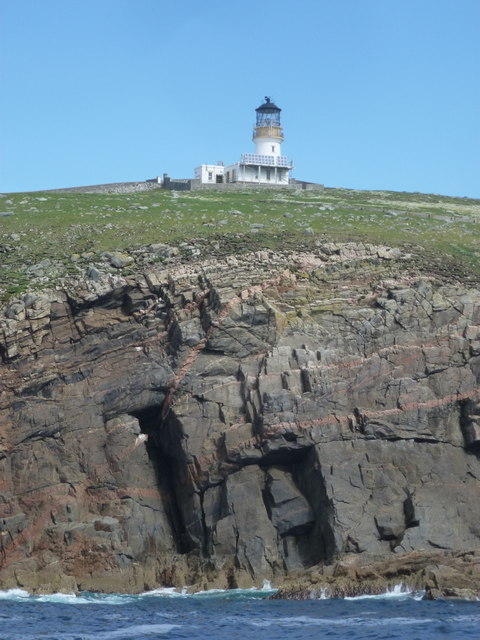
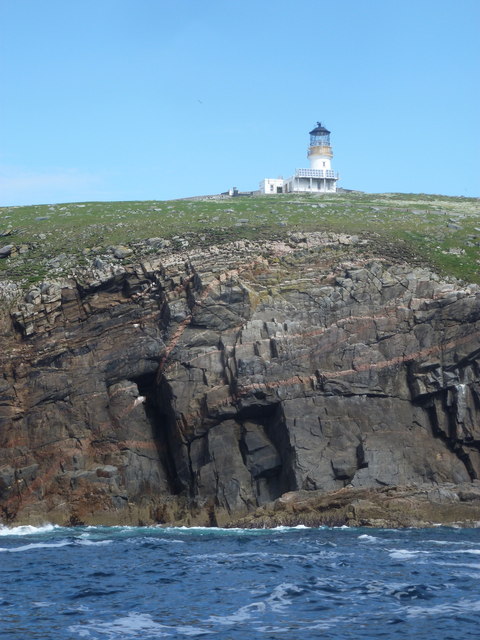
The wooden storage box — secured in a rock crevice approximately 110 feet above sea level — had been smashed open and its contents scattered. Iron railings around the crane platform were bent over and wrenched from their concrete sockets. The iron railway track had been torn from its mountings. A rock weighing more than a ton had been displaced. A life buoy mounted on the railings had been torn away, canvas and all. Turf had been ripped from the cliff face well back from an edge that was already over 60 metres high.
This damage — at 110 feet above sea level — cannot be explained by ordinary wave action. It required water reaching those elevations with enough force to bend iron and move stone.
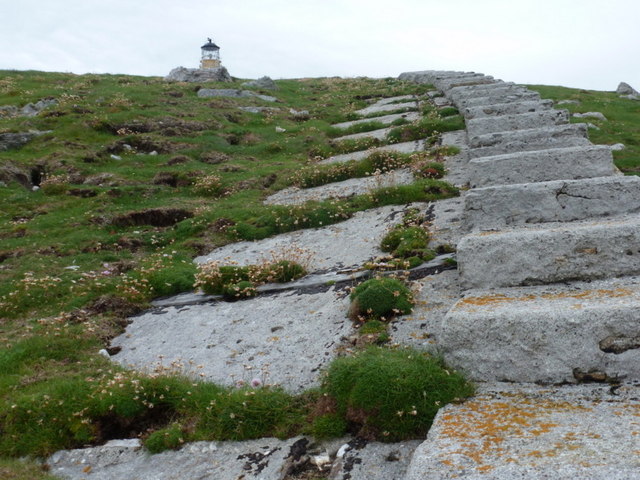
The Geo: Why 110 Feet Is Not Impossible
The west landing of Eilean Mòr sits at or near a geo — a long, deep cleft running from the sea into the cliff face and terminating in a sea cave. Geos are common features of exposed Atlantic cliff coasts, and they are exceptionally dangerous in heavy swell. When a large wave enters a geo, the narrowing walls compress the water column and accelerate it upward. When it reaches the cave end and reflects, the combined incoming and reflected energy can project water to heights far exceeding the original wave. The amplification factor can be extreme even in moderately rough conditions — nothing approaching the "waves reaching 100 metres up the cliff face" that Principal Keeper Walter Aldebert documented from his own time stationed on Eilean Mòr in the 1950s requires an outlier storm to produce. It requires the right wave angle entering the right geo geometry.
The North Atlantic northwest of the Outer Hebrides is now classified as one of the world's most active rogue-wave environments. Uninterrupted fetch — the distance over open water across which wind can generate waves — allows wave energy to travel from the eastern American seaboard to Scotland without obstruction, and different wave systems can combine through constructive interference to produce individual waves dramatically larger than the surrounding sea state. Since the Draupner oil rig in the North Sea recorded an 18.5-metre rogue wave instrumentally in 1995 — the first confirmed instrumental measurement — satellite data has identified dozens of waves exceeding 25 metres. The science that would have explained the Flannan Isles damage didn't exist in 1900. It does now.
The Sequence
Muirhead's conclusion, stated in his January 1901 report, was this: the men had been on duty until dinnertime on 15 December; they had gone down to the west landing to secure the storage box in the rock crevice at 110 feet; an exceptionally large wave had come up the cliff face and swept them away.
The clothing distribution supports a specific sequence. Ducat and Marshall dressed for the west landing — sea boots, waterproofs — and went down to secure equipment during or after a period of heavy seas. McArthur, at or near the lighthouse, saw or heard something wrong and went out immediately without stopping for his coat. He did not come back either.
Walter Aldebert, who studied the island's geo structure during his own posting in the 1950s, proposed a slight variant that is consistent with the evidence: one man was caught and swept away at the landing, and the other two lost their lives attempting to reach him. This pattern — where bystanders are taken by successive waves while trying to rescue an initial victim — is well documented at geo locations. It would explain why all three men's effects remained in the lighthouse with no sign of any gathering or preparation for departure.
No bodies were ever found. The Atlantic current in that area would have ensured they were not.
What the Fiction Did to the Facts
The 1929 logbook fabrication and Gibson's 1912 poem did something specific to this case: they replaced a physically coherent accident with a psychologically ambiguous haunting. If the keepers were weeping in their log and praying together for days before they died, something stranger than a wave must have been happening. That framing — the supernatural undercurrent, the suggestion of terror without visible cause — is what made the Flannan Isles mystery famous and kept it famous. It is also almost entirely fictional.
The actual record describes three experienced men doing their job in dangerous conditions and dying because of it. The wave that hit the west landing at 110 feet above sea level is strange enough. The storage box smashed in a rock crevice well above the cliff edge, the iron railings bent from their sockets, the life buoy torn clean away — this is not ordinary weather damage. It does not require an invented logbook or a poem to be remarkable. It requires only the North Atlantic doing what the North Atlantic does.
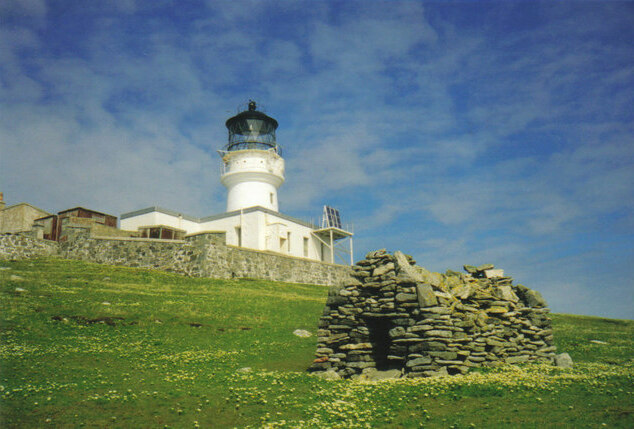
The Light Today
The Flannan Isles Lighthouse was automated on 28 September 1971. It still operates — solar-powered now, inspected annually by the Northern Lighthouse Board vessel NLV Pharos. The ruined chapel of Saint Flannan remains on the island. The NLB is explicit: public access is not permitted to the lighthouse buildings.
Eilean Mòr can be visited by private charter from the Isle of Lewis — operators such as Seatrek occasionally include the Flannan Isles in multi-day cruises — but landings are entirely weather-dependent. The cliffs are sheer on all sides. The west landing, where the damage was found in December 1900, is still there. So is the geo that may have amplified the wave that killed the men. Neither has changed.
The lighthouse keeper register at the National Records of Scotland has four entries for Ducat and Marshall marked in red ink: "Disappeared on or about 15 December 1900." The death register for the district of Carloway, Isle of Lewis, records all three men on the same page. Cause of death: probably drowning.